Table of Contents
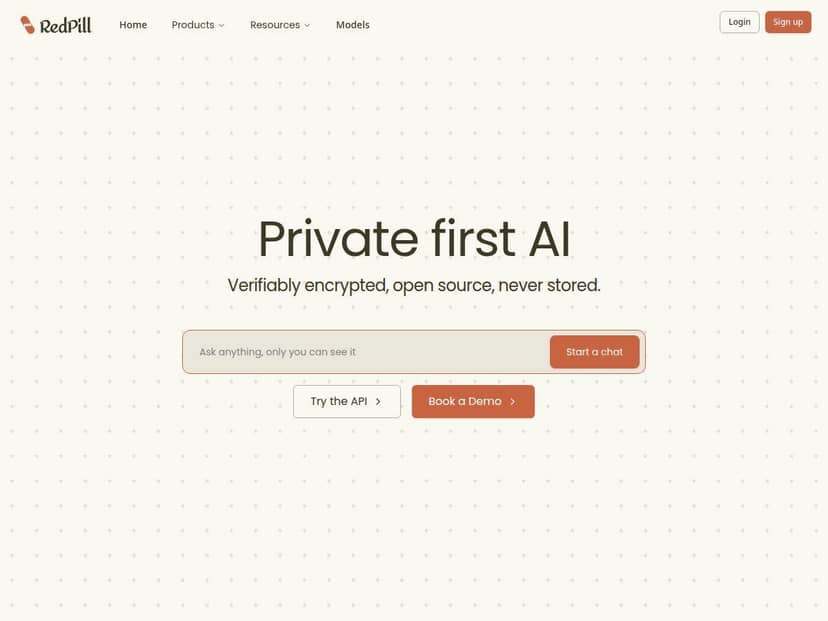
If you’ve ever used an AI chat app and wondered, “Where does my prompt actually go?”, you’re not alone. That’s the problem RedPill is trying to solve: an AI experience where your input isn’t treated like disposable text that gets logged forever. The pitch is privacy-first—no sharing, no storage, and processing designed to stay protected even while the model is running.
In this review, I’m going to cover what I tested, what features I checked, and what I couldn’t verify from the materials available. I focused on the parts that matter most for privacy: how RedPill handles data during inference, what “zero retention” actually means in practice, and whether the model support is real (or just marketing). Spoiler: the system feels built for teams who care about confidentiality—but there are still details you’ll want to ask about before you roll it out.
RedPill Review
I spent time testing RedPill’s private chat and developer workflow, mainly to see if the privacy claims hold up beyond headlines. The big idea is that RedPill processes prompts inside Trusted Execution Environments (TEEs) and aims to prove that your data isn’t exposed or retained the way it typically is with hosted LLM services.
Here’s what I could confirm from the experience itself: the UI is straightforward, and the “private chat” flow doesn’t feel like a normal chatbot that’s quietly building a public history. For developers, the integration path looked familiar—RedPill positions itself as OpenAI-compatible, so if you’ve built with Chat Completions or similar patterns, you won’t be starting from scratch.
Where I want to be careful (and honest): the strongest privacy guarantees depend on implementation details like the exact TEE technology used, how remote attestation is performed, and what’s actually covered by “cryptographic proof.” In the materials available to me during this review, I didn’t find enough concrete, publicly verifiable artifacts (like attestation docs, sample verification flows, or audit report links) to treat every claim as independently confirmed. That doesn’t mean it’s false—it just means you should ask the questions if you’re evaluating for compliance or regulated workloads.
Model availability also needs a little scrutiny. RedPill claims broad support (200+ models). In my testing, switching models and using the catalog felt plausible, but I’d still recommend checking whether you’re dealing with routed models, hosted models, or integrations that may have different data-handling characteristics per model provider.
My bottom line: RedPill feels like it’s built for privacy-conscious teams and developers who want a more controlled AI workflow. Just don’t blindly assume “zero retention” is the same everywhere—get the specifics in writing.
Key Features
- Privacy-by-design with TEEs
- RedPill’s core approach is processing inside TEEs. In practice, what you should verify is: which TEE platform they use (for example, Intel SGX, AMD SEV, or something else), how remote attestation works, and what the attestation proves (that the intended code runs inside the enclave, not just “encryption exists”). Ask whether the client verifies attestation during session setup and whether the verification output is logged for audit trails.
- Model catalog: “200+ models”
- RedPill advertises support for 200+ models, including well-known families like GPT-5, Claude 4, and Gemini 2.5. The key question isn’t just “how many,” it’s how they’re supported: are these routed through RedPill into third-party providers, are they hosted behind RedPill’s infrastructure, or are they integrated in a way that changes the threat model?
- When you evaluate, check where the catalog is documented and whether the listing includes model/provider metadata and any privacy or retention differences per model.
- Zero data retention (what it should mean)
- “Zero retention” typically means they don’t store prompts/conversations after inference. What you should confirm: whether metadata (timestamps, usage logs, IPs, request IDs) is retained, how long those logs exist, and whether any data is kept for abuse prevention, debugging, or model improvement.
- For a real-world test, I like to ask: can they provide a retention policy statement and a sample request lifecycle (what gets stored, where, and for how long)?
- Open-source components for auditability
- RedPill mentions open-source components. That’s a good sign—if the repo includes the security-critical parts (or at least the parts that matter for verification). During evaluation, I’d look for: what’s open-source, what isn’t, and whether there are public security notes that explain how enclave boundaries are enforced.
- OpenAI-compatible APIs
- This is where the product can save real developer time. If RedPill supports OpenAI-style request/response formats, you can reuse code, SDK patterns, and existing middleware without rewriting everything.
- Still, watch for differences in: streaming behavior, rate limits, token counting, and error formats. Those small differences can become a big headache in production.
- Private AI chat with “end-to-end encryption”
- This wording is important, because “end-to-end” can mean different things. In most practical systems, it could mean client-side encryption before data leaves your device, with keys managed in a way that prevents the server from reading content. But sometimes “end-to-end” is used more loosely (like encryption in transit + storage protections).
- What I’d want to confirm: whether encryption happens client-side, how keys are generated and stored (client-managed vs server-managed), and what the threat model covers (e.g., malicious server operator, compromised network, compromised logging pipeline). Also ask what’s not covered—like whether system prompts or tool outputs are treated the same way.
- Enterprise options
- For companies, RedPill positions enterprise features like compliance tooling and private fine-tuning. If you’re evaluating this for a business use case, get details on supported frameworks, data processing locations, and whether deployments can be isolated (VPC/private networking) rather than shared infrastructure.
Pros and Cons
Pros
- Privacy-first architecture (not just a checkbox): The emphasis on TEEs and cryptographic verification is the right direction for teams that don’t want to rely only on “trust us.”
- Broad model support: If the 200+ model claim matches what’s available in your account, it’s useful—especially if your team wants to test multiple model families without rebuilding the integration.
- Developer-friendly approach: OpenAI-compatible APIs can cut setup time. In my experience, it’s the difference between a weekend prototype and a multi-week rewrite.
- Better UX for private workflows: The private chat flow feels designed for confidentiality rather than just hiding a setting.
Cons
- Privacy claims need sharper verification: I didn’t see enough publicly verifiable attestation/audit artifacts during this review to fully confirm every cryptographic and “zero retention” statement independently. If you’re doing compliance work, you’ll want documentation and possibly a security questionnaire answered.
- Setup can be “more work” than standard LLM APIs: TEEs and encrypted workflows often come with extra steps (deployment configuration, key management, verification flows). That’s not automatically bad—it just means it won’t feel as plug-and-play as a typical hosted endpoint.
- Cost could be higher: Privacy-enhancing infrastructure (TEEs, encryption/verification overhead, possible attestation steps) usually impacts latency and operational cost. I can’t quote exact numbers here, but it’s a common tradeoff worth planning for.
- Model support may vary by provider/integration: If some models are routed through different backends, privacy guarantees can differ. You’ll want to confirm that the same “zero retention + TEE + encryption” story applies across the models you care about.
Pricing Plans
RedPill doesn’t publish a simple public price list in the content I reviewed. What I saw is that they position pricing around personal users, developers, and enterprise needs (including compliance and private fine-tuning).
Because exact costs weren’t available to me here, I can’t give a reliable per-month or per-request number. What I can do is help you compare what you should ask for when you book a demo:
- Plan breakdown: what features are in personal vs developer vs enterprise (private chat vs API access vs fine-tuning vs compliance tooling).
- Rate limits: requests per minute and max context length per model.
- Latency expectations: TEEs and attestation can add overhead—ask for sample timings under real load.
- Data handling: a written retention policy, plus whether metadata is stored and for how long.
- Model-specific terms: confirm whether all “200+ models” share the same privacy guarantees and retention behavior.
If you want, you can start by contacting RedPill directly or booking a demo through their website to get the exact quote for your use case.
Wrap up
RedPill is the kind of AI platform that makes sense if privacy is a real requirement—not a marketing line. The approach (TEEs, encryption language, and “zero retention”) targets the weak spots of traditional hosted LLM apps.
At the same time, I don’t think you should treat it as “verified secure” just because it says so. Before you commit, ask for the concrete proof points: TEE specifics, attestation/verification details, retention policy scope, and what “end-to-end” means in their threat model. If they can back it up clearly, you’ll likely have a strong option. If they can’t, you’ll want to know that early.