Table of Contents
If you run a small or mid-sized business, you already own more data than you can realistically read — orders, ad spend, CRM notes, support tickets. The hard part is turning that pile into a decision you can act on before the week is over. Electe is an AI data-analytics platform built specifically for that problem: it imports your data, finds the patterns, and generates a clean report in one click — no analyst required. This Electe review covers exactly what it does, current 2026 pricing, where it shines, where it falls short, and who should (and shouldn't) use it.
⚡ TL;DR – Electe Review
- What it is: an AI-powered data-analytics and reporting tool aimed at SMEs that don't have a data team.
- Best feature: one-click, visually clean reports built automatically from imported data — pattern-spotting and predictive analytics without writing code.
- Pricing: €39/month (Starter), €49/month (Professional), €59/month (Enterprise), billed monthly or cheaper annually — all excluding VAT (source: Tekpon).
- Rating: Tekpon Score 4.5/5 as of 2026.
- Verdict: a strong, affordable pick if you want dashboards and reports fast and don't need the deep customization of Power BI or Tableau.

What Is Electe?
Electe is an AI data-analytics platform built and maintained by Electe S.r.l., an Italian company founded in 2023 with the goal of making data science accessible to businesses that can't afford a dedicated analytics team (Tekpon). Instead of asking you to build dashboards from scratch, Electe connects to your existing tools, imports and cleans the data automatically, then uses machine learning and statistical models to surface trends, anomalies, and forecasts. The headline promise from its launch coverage is blunt: enterprise-grade analytics for SMEs for under €50 a month (Newstrail).
In practice, that means a marketing lead can drop in a spreadsheet of campaign results and get a readable report — with charts and plain-language insights — in minutes rather than hiring someone to build it. If you're already exploring AI for data analytics tools, Electe sits at the accessible, done-for-you end of that spectrum.
Key Features
Automatic data import and preprocessing
Electe pulls data from multiple sources and handles the tedious cleanup — deduplication, formatting, and preprocessing — before analysis. This is the step most SMEs get stuck on, and automating it is where the tool saves the most time.
AI pattern recognition and predictive analytics
Using machine-learning and statistical techniques, Electe identifies significant patterns and trends and produces forward-looking predictions, so you're not only reporting on what happened but getting a read on what's likely next.
One-click report generation
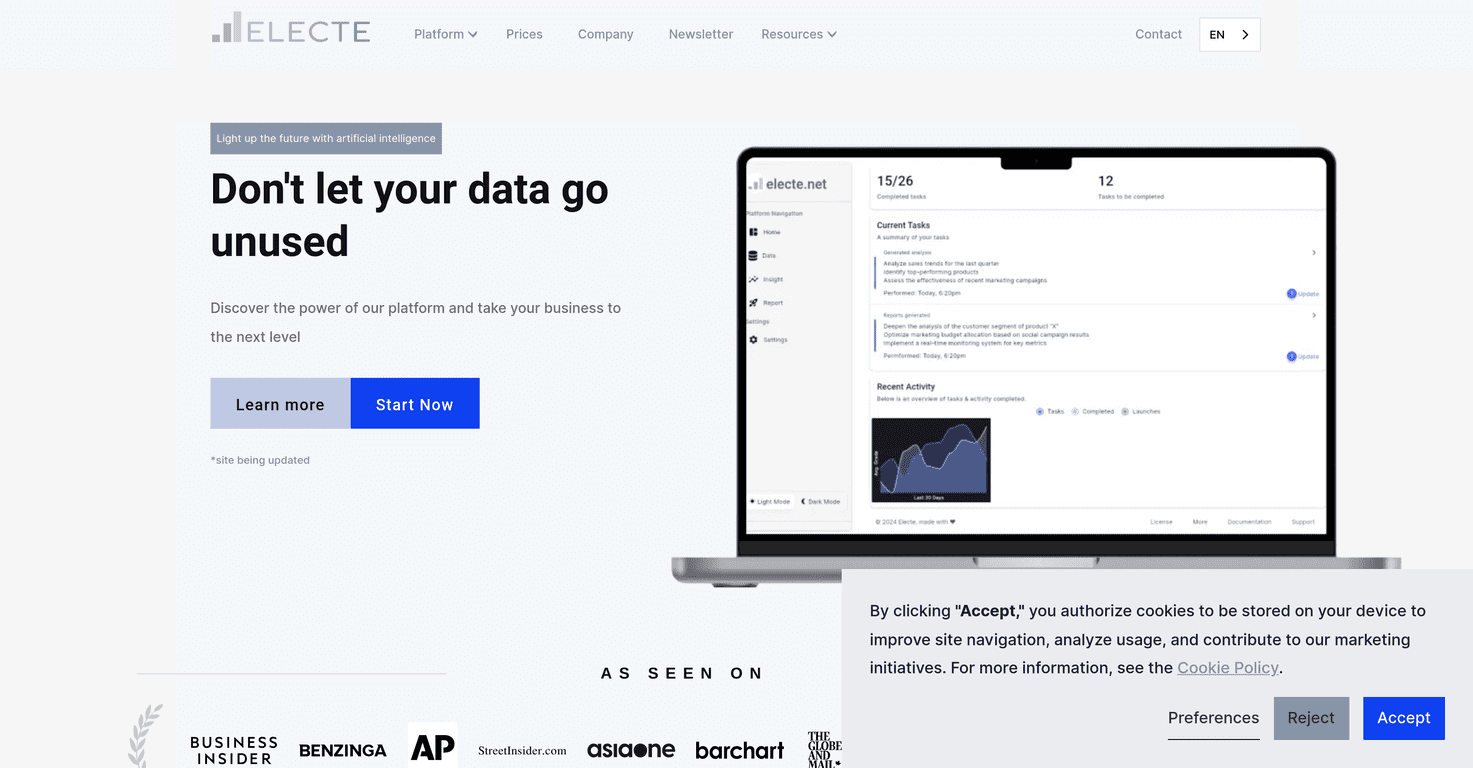
The signature feature: customized, visually appealing reports generated with a single click. Findings are presented clearly enough that a non-technical stakeholder can understand them without a walkthrough.
Interactive dashboards and visualization
Real-time dashboards with clear data visualization let teams track metrics as they change. Higher plans include unlimited dashboards and reports.
Integrations
Electe connects with common CRM, marketing, sales, social-media, and project-management tools, plus API access on higher tiers, so data flows in without manual exports.
Collaboration and access control
Real-time collaboration, role-based access, and log history are available on the paid tiers, making it workable for a whole team rather than a single analyst.
Electe Pricing Plans (2026)
Electe uses a straightforward subscription model with three tiers. All prices below exclude VAT and reflect the rates listed on Tekpon as of 2026; annual billing lowers the effective monthly cost.
| Plan | Price (excl. VAT) | Best for | Highlights |
|---|---|---|---|
| Starter | €39/mo (€379/yr) | Solo founders & very small teams | 1 user, up to 500,000 rows, unlimited reports & dashboards |
| Professional | €49/mo (€469/yr) | Growing teams | Up to 20 users, advanced reporting |
| Enterprise | €59/mo (€569/yr) | Data-heavy SMEs | Up to 20 users, real-time collaboration, premium/priority support |
For context, that Enterprise tier still lands under €60/month — cheaper than adding a single seat of many legacy BI suites once you factor in setup. Electe also offers a free trial so you can test it against your own data before committing.
Pros and Cons
Pros
- Automates the whole pipeline — cleaning, pattern recognition, and reporting — with no code required.
- Genuinely affordable: every tier is under €60/month, with unlimited reports and dashboards even on Starter.
- One-click reports are readable by non-technical stakeholders.
- Scales from a solo founder to a 20-person team.
- Solid third-party rating (4.5/5 on Tekpon) and integrations with common business tools.
Cons
- Support is limited on the Starter plan; priority support is reserved for higher tiers.
- You still need a basic understanding of your own metrics to interpret results well.
- Less deep customization than heavyweight BI tools like Power BI or Tableau.
- Pricing is quoted in euros and excludes VAT, which can surprise non-EU buyers.
Who Is Electe Best For?
Electe is a strong fit for small and mid-sized businesses that have data but no analyst — e-commerce stores, agencies, and lean SaaS teams that want dashboards and reports without a big BI project. It's also useful for founders who want a fast, plain-language read on performance. It's a weaker fit if you need pixel-level custom visualizations, on-premise data, or the enterprise governance features of a tool like Tableau. If you're comparing options broadly, our roundup of the top AI tools for small business puts platforms like this in context.
How Electe Compares to Alternatives
The most common alternatives are Microsoft Power BI (from about $10/user/month), Tableau, Domo, and lighter tools like Datawisp and ExcelDashboard AI. Power BI and Tableau offer far deeper customization and are the standard for larger data teams, but they carry a steeper learning curve and, in Tableau's case, higher per-seat cost. Electe's pitch is the opposite trade-off: less configurability in exchange for speed, automation, and a flat, predictable price. If your goal is "show me what my data means without a two-week setup," Electe wins that comparison; if you need a fully bespoke analytics stack, the incumbents still lead. For a wider view of the category, see our guide to the top AI tools for data analysis.
My Take
I've reviewed a lot of AI tools while building Automateed, and the pattern with SME analytics is always the same: the software isn't the bottleneck — the setup is. Electe's real value is that it collapses the "import, clean, model, visualize, report" chain into something a busy owner will actually use on a Monday morning. It won't replace a dedicated data team for a large enterprise, but for the businesses it targets, getting a readable, forecasted report for under €50/month is a fair deal. Try the free trial with one real dataset before you decide — that'll tell you more than any review, including this one.
Frequently Asked Questions
What does Electe do?
Electe is an AI data-analytics platform that imports your business data, cleans and analyzes it with machine learning, and generates visual reports and dashboards in one click — designed so non-technical SME teams can make data-driven decisions without an analyst.
How much does Electe cost?
Electe has three plans: Starter at €39/month, Professional at €49/month, and Enterprise at €59/month (all excluding VAT), with cheaper annual billing and a free trial (Tekpon).
Is Electe good for small businesses?
Yes — it's built specifically for SMEs. Every plan includes unlimited reports and dashboards, and it automates the data-prep work that usually requires a specialist, which is exactly what small teams lack.
What are the best Electe alternatives?
The main alternatives are Microsoft Power BI, Tableau, Domo, Datawisp, and ExcelDashboard AI. Power BI and Tableau offer deeper customization; Electe competes on automation, ease of use, and a lower flat price.
Does Electe require coding skills?
No. Electe automates data cleaning, analysis, and reporting end-to-end, so you can generate insights without writing any code.