Table of Contents
Meetings are supposed to be productive. In my experience, they’re often the opposite—too many side conversations, someone’s talking through a key decision, and suddenly you’re scrambling to figure out what you’re actually supposed to do next. That’s where Vexa caught my attention.
Vexa is an AI meeting companion built to help you stay engaged and keep track of the important bits while the conversation is happening. It listens in real time, pulls out decisions and action items, and even tries to make sense of jargon as it comes up. I tested it in a few work-style calls (the kind with lots of “just to clarify…” and acronyms flying around), and the biggest thing I noticed was how much easier it was to re-orient myself after I got briefly distracted.
Vexa Review: What It’s Like in Real Meetings
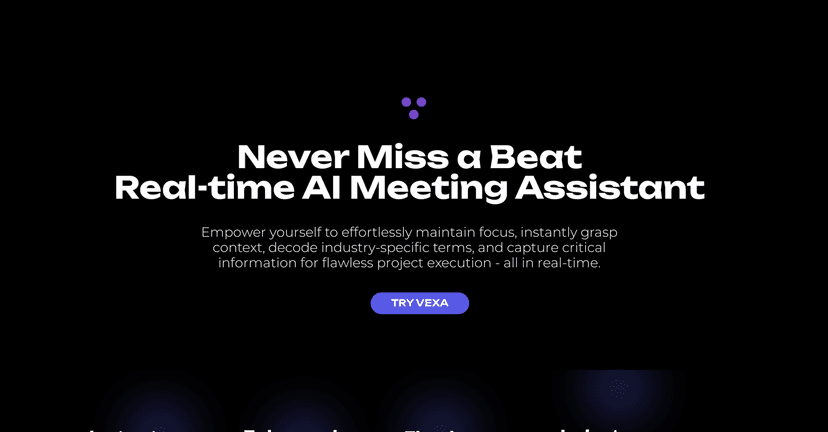
Vexa is positioned as an AI meeting assistant powered by GPT-4. The idea is simple: during your call, it analyzes what’s being said, then surfaces the stuff you actually need—decisions, tasks, and key context—without you having to take perfect notes. And honestly, that’s the promise that matters. Because most of us don’t want to turn into full-time notetakers during a live meeting. We want to participate.
Here’s what I liked most after using it a handful of times:
- It helps you stay “in the room.” When you’re listening and working at the same time, it’s easy to miss a detail. Vexa makes it easier to catch up without having to rewind the entire meeting.
- Jargon doesn’t automatically become a blocker. In technical or industry-heavy discussions, people toss around terms like they’re obvious. Vexa’s “decoder” approach made those moments less stressful—at least enough that I could keep up instead of mentally pausing.
- Re-engaging after distractions is way faster. I’m not proud of it, but I’ve had meetings where I glance at an email for 30 seconds and then realize I’ve missed a decision. Vexa made it much easier to jump back in and understand what changed.
That said, it’s still AI. It won’t magically replace your judgment or your need to confirm details—especially if your team is using highly specific internal language. But as a companion that reduces the “wait, what did they decide?” feeling? It does a pretty good job.
Key Features That Actually Matter
- Real-Time AI Meeting Assistance: Keeps you engaged and informed during meetings. In practice, this means you’re not only listening—you’re also getting helpful context while the conversation is still happening.
- Instant Context Recovery: Lets you re-engage quickly after you drift. This is the feature I cared about most, because missing a few lines in a 60-minute meeting can snowball fast.
- Flawless Project Execution (Action capture): It’s built to record agreements, deadlines, and responsibilities. I found the most useful part was not having to manually assemble tasks from scattered comments.
- Industry Terminology Decoder: Clarifies jargon and technical language in real-time. If your meetings include acronyms, product names, or “we call it X but it’s really Y” explanations, this can save you from sounding confused later.
- Enhanced Focus and Productivity: Designed to help you stay sharp during long meetings. The mental load drops when you don’t feel like you must write down everything.
- Adaptive to Distractions: The promise here is that it catches details you might miss. What I noticed was that it made it easier to follow the thread even when I wasn’t 100% locked in the whole time.
- Live Transcription: Provides visual cues for easier reading and comprehension. This helps when audio is unclear or when you prefer reading to listening.
- Task Management: Creates prioritized task lists based on meeting discussions. The practical win is having a starting point for follow-up, not a blank page.
Pros and Cons (My Honest Take)
Pros
- Better meeting efficiency: Follow-ups feel faster because you’re not reconstructing decisions from memory.
- Fewer distractions: It’s easier to stay focused when you trust the assistant to capture the important parts.
- Works well for long calls: It reduces mental fatigue—especially when meetings run long or drift into multiple topics.
- Helps with complex language: If your team uses industry-specific terms, it’s easier to stay aligned.
Cons
- Not everyone will want to rely on it: If you’re used to traditional note-taking and controlling the process yourself, you might find this approach a bit different.
- Free version limitations: Like most AI tools, the free tier doesn’t give you the full experience. You’ll likely want to test the Pro features to see if it’s worth paying for.
- Accuracy still depends on the meeting: If audio quality is rough, multiple people talk over each other, or the group uses very internal shorthand, you may need to double-check what it captured.
Pricing Plans: What You’ll Pay
Vexa offers a Free Plan with limited access to GPT-4. If you want the more capable feature set, there’s a Pro Plan at $20 per seat/month (aimed at enhanced features and personal support). For larger teams, Vexa also lists Enterprise pricing, which is typically where you’d expect options like onboarding, team controls, and possible integrations.
If you’re evaluating it for your workflow, I’d suggest doing a couple of real meetings on the free tier first. Then ask yourself: did it save you time on follow-up? Did it help you participate more confidently? If the answer is yes, $20/seat starts to look a lot more reasonable.
Wrap Up
After using Vexa, my takeaway is pretty straightforward: it’s a strong “meeting companion” for people who want to stay present and still walk away with clear decisions and next steps. It won’t replace good facilitation or your team’s need to confirm tricky details, but it does reduce the usual friction—especially the part where you’re trying to remember what was decided while everyone else moves on.
If you’ve got lots of recurring meetings (planning, status updates, project reviews) and you’re tired of the note-taking scramble, Vexa is worth trying. And if it clicks with your team’s style of communication, it can genuinely make meetings feel less stressful and more actionable.