Table of Contents
If you run customer support, you already know the “busy work” problem: same questions, same follow-ups, same copy/paste… over and over. That’s why I was interested in PixieBrix in the first place. It’s not a full helpdesk replacement—it’s a browser extension that sits on top of the tools you already use and tries to help you respond faster (and more consistently).
In my case, I tested it with a pretty typical support setup: a ticketing inbox in a web app, plus a knowledge base page and a few internal docs I use when I’m answering. I focused on three things: (1) how well it recommends what to say, (2) whether it can automate repetitive steps without breaking anything, and (3) what the setup experience feels like when you’re not trying to “rebuild your stack.”
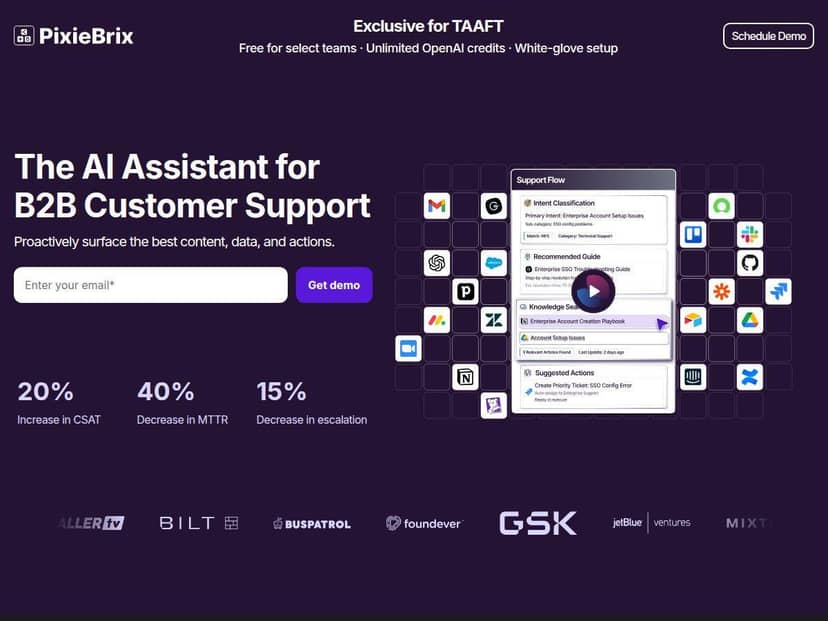
PixieBrix Review: How It Fits Into a Real Support Workflow
Here’s what I liked right away: PixieBrix doesn’t demand that you change your whole ticketing process. It’s built as a browser extension, so it can observe what you’re doing on-screen and then help you with context—like suggesting responses or taking over small repetitive actions.
To keep this practical, I ran a few “support day” scenarios instead of just clicking around. I used it across common moments where time disappears:
- First response drafting when a ticket came in and I needed to write something accurate fast.
- Classification and routing steps where support folks often choose tags, categories, or next actions manually.
- Follow-up workflows where you repeat the same steps (check order status, confirm details, update internal notes, then respond).
What I noticed in the recommendations: the biggest win wasn’t “magic AI answers.” It was the way suggestions appeared at the moment I needed them. For example, when I had a ticket open and I referenced a knowledge base article, PixieBrix surfaced relevant content/actions without me hunting for the right template every time. That’s the kind of speed boost that actually shows up in day-to-day work.
What I noticed in the automation: PixieBrix’s automations are more “attended” than “set-and-forget.” In other words, it’s designed to help a human operator do the next steps faster, with less clicking. That matters because support teams usually don’t want robots firing off actions blindly—especially when refunds, account changes, or shipping updates are involved.
One limitation I ran into: if you expect out-of-the-box dashboards and deep KPI reporting, you might feel a bit underwhelmed at first. The core experience is the in-browser assistance and automation. Measuring impact is still possible, but you’ll likely be doing some manual comparison (before/after time on task, error checks, and QA sampling) rather than relying on a fully baked analytics suite.
So, does it “replace” your support stack? No. But it can reduce the friction inside your existing stack—which, honestly, is where most support teams lose time.
Key Features: What PixieBrix Actually Does
- Contextual Recommendations (in real time)
Instead of sending you off to another screen, PixieBrix tries to surface the right suggestion while you’re working. In practice, this looked like getting help with what to say next, plus shortcuts to the actions that usually follow (like linking to the correct policy or selecting the next workflow step). - Seamless integration with your web apps
Because it’s a browser extension, it can work with the tools you already open in Chrome. I didn’t have to rebuild my ticketing workflow—PixieBrix just “joined” the session when I was inside the web UI. - Low-code automation builder
This is the feature that makes it feel usable by non-developers. You’re not writing a bunch of code to automate common actions. You define triggers and map out what should happen when a condition is met—things like: “when the ticket is tagged as X, pull a specific template, ask for missing info, then update the ticket notes.” - Attended automation (human + AI collaboration)
I like this approach because support work is nuanced. With attended automation, you can keep a human in the loop for anything risky. The AI/automation can do the repetitive steps, but you still review and confirm the final message or action. - Secure, in-browser operations (private handling emphasis)
PixieBrix focuses on operating in the browser context rather than forcing you to move everything into a new system. That said, you should still confirm your security and compliance needs with the vendor—especially if you handle regulated data. In my opinion, “secure by design” is only useful if it’s clearly documented for your environment.
Example automations I’d actually try first
If you’re evaluating PixieBrix, start with small automations. Don’t begin with the most complex edge cases. Here are three examples that map well to real support work:
- Refund request triage
Trigger: ticket contains keywords like “refund,” “chargeback,” or “cancel.”
Automation: suggest the correct refund policy snippet, prompt for missing order details (order ID, email, date), and pre-fill a draft response. Human review stays in control before anything is sent. - Knowledge-base suggestion for first replies
Trigger: ticket category = “billing” or “pricing.”
Automation: surface the top relevant article(s) and insert a short response skeleton that matches your tone. This reduces the “search → read → retype → send” loop. - Follow-up workflow for missing information
Trigger: ticket status = “needs info.”
Automation: draft a follow-up message, include a checklist of exactly what’s missing, and update internal notes with a consistent format.
Those are the kinds of workflows where you’ll feel improvements quickly—because they’re repetitive and easy to verify.
Pros and Cons (Based on How It Felt in Use)
Pros
- It reduces clicking and copy/paste
The benefit isn’t just “AI text.” It’s the way PixieBrix helps you move through the same steps faster inside your existing web tools. - Customizable with real workflow rules
When I say “customizable,” I mean you can set up automations around triggers and conditions (like ticket tags, page context, or specific support categories) instead of only relying on generic suggestions. - Low-code setup is approachable
You don’t need to be a developer to get started. It’s the kind of tool you can get running with a few test automations and then iterate. - Attended automation fits support reality
Support teams need oversight. The human-in-the-loop approach makes it easier to roll out without worrying that everything will run unsafely.
Cons
- It’s browser-based (Chrome extension)
If your team lives in another environment (or you need deep automation outside the browser), PixieBrix may not cover everything you want. - Advanced setups may require more effort
The “easy” part is getting basic automations working. The more complex you go (multi-step flows, edge cases, lots of conditional logic), the more time you’ll spend testing and adjusting. - Public details on OpenAI credit usage aren’t clear
If you’re budgeting tightly, you’ll want to confirm how AI usage is metered and whether there’s a documented policy for token/credit consumption. I didn’t see enough public info to confidently say “unlimited” or “fixed credits.” - Out-of-the-box KPIs aren’t the main focus
You can track results, but don’t assume it’s going to replace your existing reporting. In my experience, teams will still want QA sampling and manual time-on-task checks at first.
Pricing Plans: What to Expect (and What to Ask)
PixieBrix doesn’t publish simple self-serve pricing on the page I reviewed. They mention tailored enterprise pricing, so you should expect a sales conversation for exact numbers.
That said, here are the questions I’d ask before you sign anything—because “enterprise pricing” can mean a lot of different packaging:
- Is there a trial or demo? If yes, what’s included (features, automation limits, number of seats)?
- How is AI usage metered? Confirm the details around OpenAI credits/tokens and whether usage is capped, throttled, or billed separately.
- What’s included in each plan? Look for specifics: automation builder access, attended automation features, integrations/support for your web apps, and any SLA/support options.
- Data handling and security details (especially if you handle customer PII). Ask for documentation that matches your compliance needs.
If you’re trying to estimate ROI, I’d also suggest you track a baseline for 1–2 weeks first. Even a simple spreadsheet helps: time to draft first response, number of follow-ups needed due to missing info, and QA error rate. Then compare after you roll out 1–3 automations.
Who PixieBrix is a good fit for (and who it isn’t)
PixieBrix makes the most sense for teams that:
- Live inside web-based support tools (Chrome workflows)
- Want faster drafting and better consistency without replacing their helpdesk
- Are comfortable rolling out attended automation with human review
It might not be the best choice if you:
- Need full, system-wide automation across non-browser environments
- Require strong out-of-the-box KPI dashboards from day one
- Have very strict AI usage/budget policies and can’t get clear metering details
If you want to add AI assistance where support reps already work, PixieBrix is worth a close look. Just make sure you verify the latest feature set, integration coverage, and pricing/AI usage terms directly with PixieBrix before you commit.