Table of Contents
Ever wish your chatbot didn’t “forget” everything the moment the user asks a follow-up? I’ve been there. Memoripy is an open-source memory layer that helps AI systems keep both short-term context and longer-term details, so conversations feel less like a script and more like an actual back-and-forth. If you’re building with LLMs and you want the assistant to remember preferences, recurring topics, or past decisions, this MemoriPy review is for you.
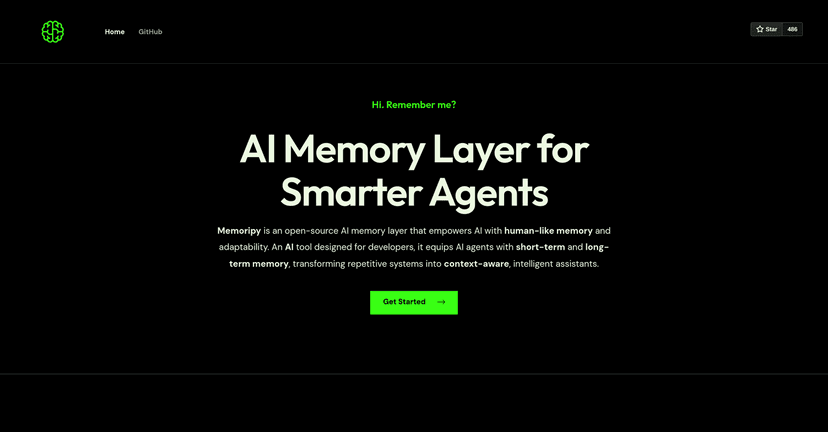
MemoriPy Review
MemoriPy’s main idea is simple: give your AI a memory layer instead of relying only on what’s in the current prompt. In my experience, that’s where most “generic” assistants fall apart—users ask something like “You said you prefer emails on Tuesdays” and the model has no idea what “you” refers to unless you keep stuffing the conversation history into every request.
With Memoripy, you get both short-term and long-term memory. Short-term helps with immediate context (things like the current task, recent instructions, or details from the last few turns). Long-term memory is where preferences and recurring facts can stick around so the assistant doesn’t feel brand new every time.
What I liked most is the practical impact on conversation quality. Instead of robotic responses that re-ask the same questions, the assistant can reference what it learned earlier. That matters for chatbots, personal assistants, and even smart retail experiences where customers expect continuity (“I bought this last month—what’s similar?”).
There’s also a cost angle here. Memoripy uses memory concepts like clustering and decay techniques (so older or less relevant memories don’t just pile up forever). The end result can be fewer unnecessary tokens, because you’re not repeatedly feeding the entire history to the LLM. And if you’ve ever watched token usage creep up during a long support thread, you already know why this is important.
Integration is another strong point. If you’re already working with OpenAI or Ollama, you won’t feel like you’re starting from scratch. Still, I’ll be honest: this isn’t “no-code magic.” If you don’t have at least some technical comfort (Python, basic setup, and wiring components together), you may need to lean on docs or community help to get it tuned correctly.
Key Features
- Human-like memory capabilities for AI (so it can reference prior context instead of starting over)
- Short-term and long-term memory integration (recent context + longer-lived details)
- Context-aware assistant development (responses that stay aligned with what the user said earlier)
- Enhanced conversation quality with meaningful responses (less repetition, more continuity)
- Reduces unnecessary repetitive queries (the assistant can “remember” what it already asked/learned)
- Cost efficiency by optimizing LLM calls and reducing token usage (helpful for longer-running chats)
- Effortless integration with platforms like OpenAI and Ollama (works with common LLM setups)
Pros and Cons
Pros
- Open-source means you can customize it. In practice, that matters when you want to tweak how memory is stored, retrieved, or aged out.
- Big improvement over “plain” LLM chat. Without memory, assistants often feel like they’re reading only the last message. With Memoripy, the experience feels more continuous.
- Works for multiple use cases. I can see it helping with support bots, habit/personal assistants, and any app where user context matters.
- Adaptive systems over time. If you set it up well, the assistant can become more useful as it learns what’s relevant to each user.
Cons
- Not always plug-and-play for beginners. You’ll likely need to understand how to connect memory to your LLM calls, and how retrieval impacts the output.
- Community support can be hit-or-miss. Since it’s open-source, your experience may depend on how active the community is and how complete the examples/docs are at the time you implement it.
Pricing Plans
MemoriPy is completely open-source, so you can use it for free. If you want to get started quickly, you can install it with:
pip install memoripy
That said, while the library is free, you’ll still want to think about your own infrastructure and LLM costs. The good news? If memory reduces the amount of context you have to resend, it can help control token usage over time.
Wrap up
For developers who want AI assistants that actually remember, Memoripy is a solid option. It adds that missing “continuity” layer—short-term context when you need it and longer-term recall when it matters. I also appreciate the focus on practical efficiency, since fewer tokens usually means lower cost and faster responses.
If you’re comfortable getting your hands a little dirty with setup and tuning, you’ll probably get a lot out of it. If you’re brand new to this stuff, you might need more time (or help) to make it work the way you want. Either way, it’s worth testing—because once an assistant stops feeling like it’s starting from zero every message, it’s hard to go back.
Promote MemoriPy