Table of Contents
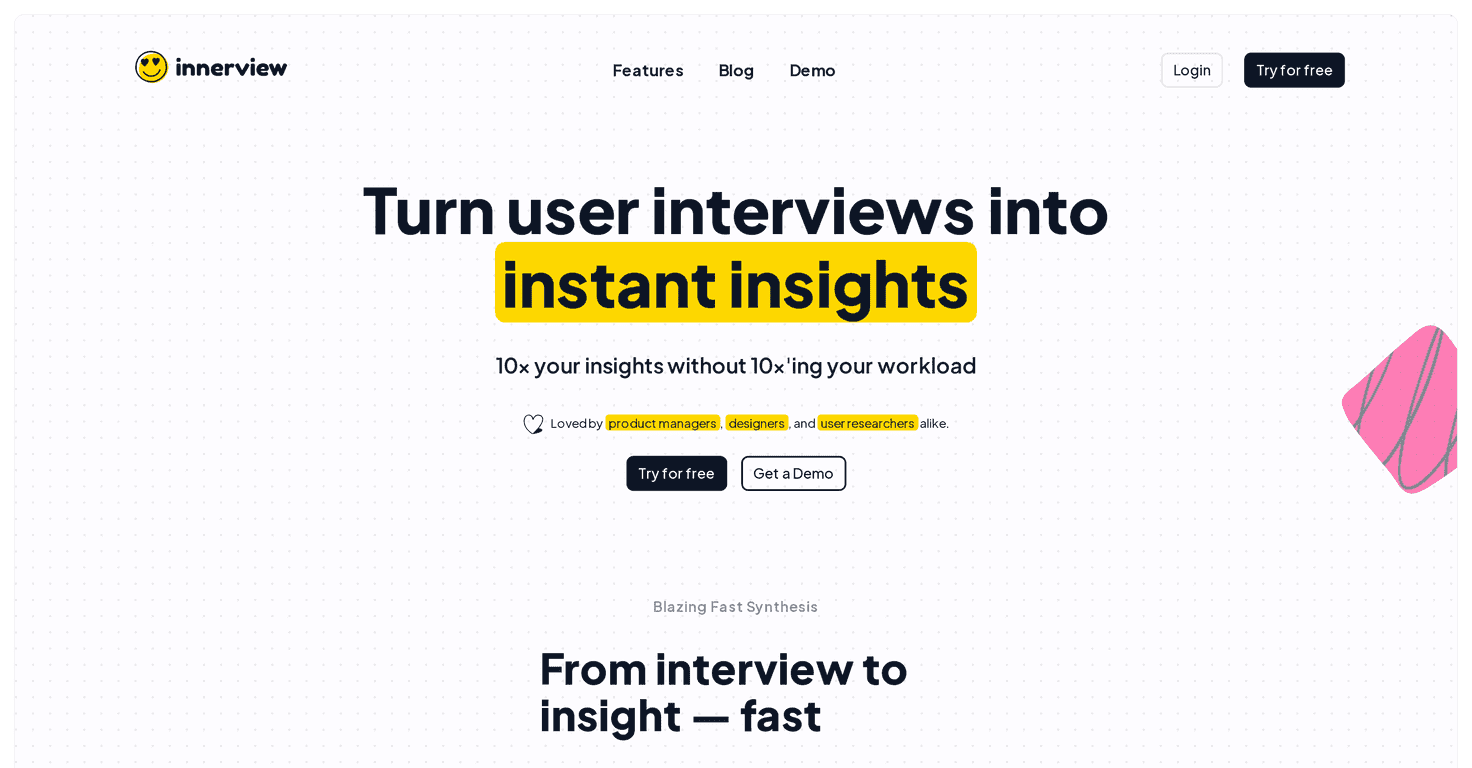
In today’s fast-paced digital world, making informed decisions quickly is essential. If you’re a user researcher, designer, or product manager, you understand the value of gathering and synthesizing qualitative data. Say hello to Innerview, a platform that turns user interviews into actionable insights. In this Innerview review, we will explore how it can enhance your research efforts and speed up decision-making.
Innerview Review
Innerview is an innovative platform designed to streamline the process of extracting insights from user interviews. By leveraging the power of artificial intelligence, it automates the analysis, enabling users to sift through interviews efficiently. The tool allows for easy searching and filtering of past interviews, making it simpler to find relevant data points for current projects. Furthermore, it segments data into ideal customer profiles, ensuring that the insights are not only insightful but also actionable.
One of the standout features of Innerview is its sentiment analysis, which evaluates user feedback and highlights key themes. Users can quickly identify trends across interviews while being pleased to know that it supports multilingual fluency for instant translations. Coupled with accurate transcription capabilities, the platform gives a holistic view of qualitative data.
Customization is another strong point; users can tailor AI prompts for more targeted insights. This adaptability enables research teams to focus on specific aspects they want to explore deeper. Additionally, the application is built with enterprise-level security in mind, offering strong encryption for sensitive data.
Key Features
- Automated analysis using AI
- Search and filter past interviews
- Segmentation into ideal customer profiles
- Sentiment analysis of user feedback
- Highlighting and aggregating important insights
- Trend identification across interviews
- Multilingual support for translations
- Accurate transcription capabilities
- Tagging of themes and insights
- Customizable AI prompts for targeted insights
- Enterprise-level security and encryption
Pros and Cons
Pros
- Saves time by extracting insights quickly
- Facilitates ongoing research and data analysis
- Supports multilingual interviews and transcription
- Offers tools for sentiment analysis and trend detection
- Secure handling of data with built-in encryption
Cons
- May have a learning curve for new users
- Potential limitations in specific industries or languages
- Requires a strong internet connection for optimal AI performance
Pricing Plans
Pricing details are not explicitly provided, but potential users can try the platform for free or request a demo for more information on pricing plans.
Wrap up
In conclusion, Innerview stands out as a powerful tool for any team looking to harness the insights gained from user interviews. While it may take some time for new users to familiarize themselves with its AI-driven features, the benefits it provides far outweigh the initial learning curve. With its comprehensive capabilities and focus on security, Innerview is an excellent investment for anyone serious about enhancing their research process.
Promote Innerview