Table of Contents
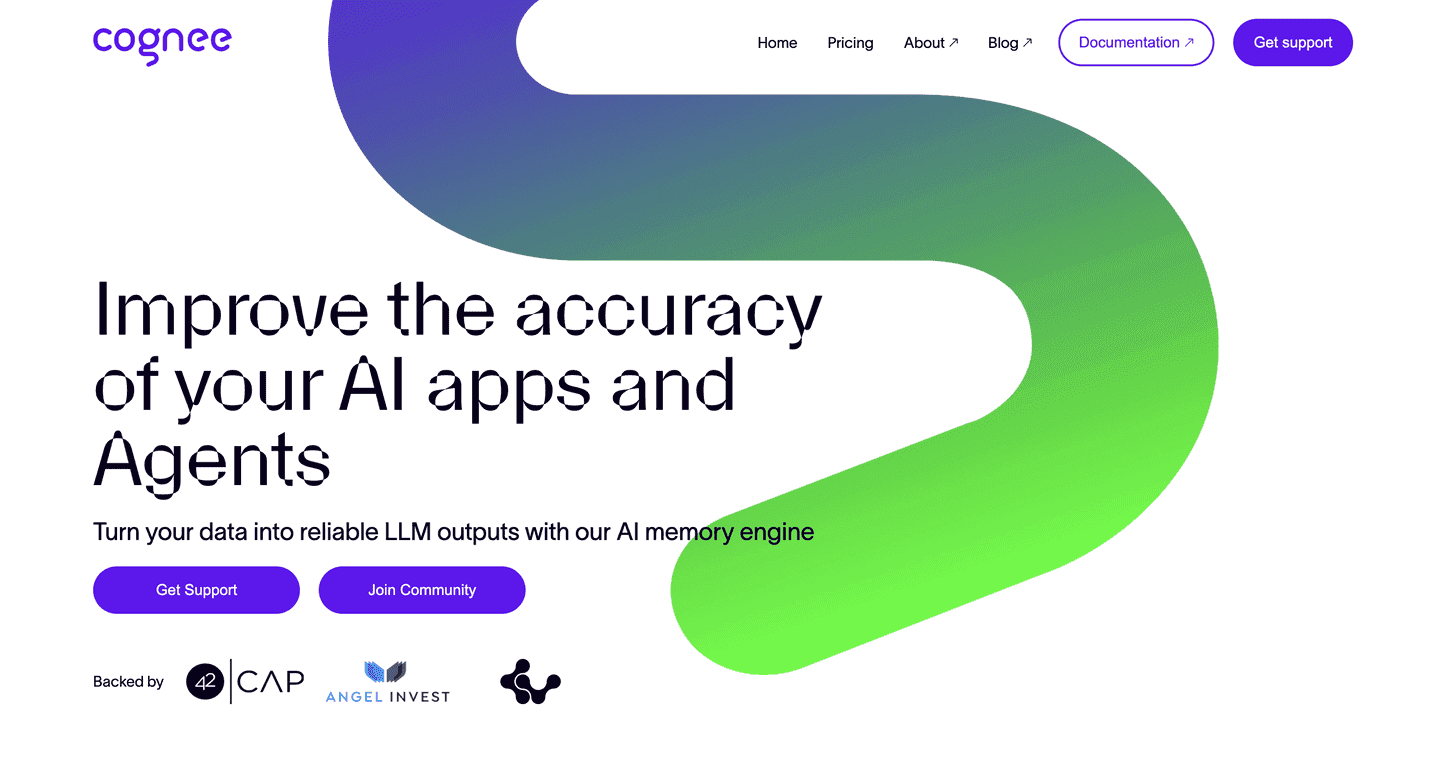
When I’m testing AI tools, I always end up asking the same question: does it actually remember what it should, or does it just shuffle text around and call it “context”? That’s why I was interested in Cognee—it’s an open-source memory engine built to mimic how humans consolidate information into something usable later.
In plain terms, Cognee is meant to help large language models (LLMs) turn messy inputs—notes, documents, media metadata, even structured data—into “memories” that can be retrieved and reused. Instead of treating every prompt like a brand-new world, the idea is that your AI system can build a better internal map over time.
One thing I liked right away is the emphasis on knowledge graphs. If you’ve worked with retrieval-augmented generation (RAG), you know the usual pain: you pull in relevant chunks, but you still don’t always capture how concepts relate. A graph-based approach can make those connections more explicit, which (in my experience) is where answers start feeling smarter and less “keyword-matched.”
Cognee also leans hard into integration. It supports 28+ standard ingestion sources, so you’re not forced to start from scratch just to get your data in. And since it’s open-source, you can customize it for your stack instead of being boxed into someone else’s defaults.
Of course, the real test is implementation. A memory engine isn’t magic by itself—garbage in still becomes garbage out. But if you’re building an AI assistant, internal knowledge system, or agent that needs continuity, Cognee looks like a solid option to explore.
Cognee Review: Human-Like Memory for LLMs
Cognee is an “AI memory engine” that aims to improve how LLMs handle information over time. Instead of relying purely on prompt context, it tries to consolidate knowledge into reusable memories—think of it like giving your model a better long-term filing system.
What makes it stand out is the combination of memory-style processing and knowledge graphs. If your application deals with lots of unstructured text (docs, tickets, emails, PDFs) plus relationships between concepts, a graph can help you surface connections that plain chunk retrieval often misses.
Here’s what I’d pay attention to if you’re evaluating Cognee for a real project:
- How consistently it turns inputs into “memories” you can retrieve later (not just embeddings that look similar).
- Whether the knowledge graph improves answer quality—for example, can it connect “policy” to “process” to “required steps” without you manually wiring everything?
- How fast you can get data in using the supported ingestion sources. If ingestion is painful, you’ll feel it immediately in dev time.
It’s also designed to be flexible. Since Cognee is open-source, you’re not stuck waiting for every feature request. You can adapt it to your infrastructure and workflows. That matters if you’re building something that needs control (data handling, deployment style, or customization).
One more thing: memory systems can get expensive if you don’t set boundaries. If you’re planning to ingest huge volumes, you’ll want to think about what you actually need to store and retrieve. Cognee can help, but you still need good product decisions.
Key Features I’d Actually Use
- Memory Engine that mimics human cognitive processes (the core idea: consolidation + retrieval, not just stateless responses)
- Support for multiple data types, including unstructured text and PDFs
- Knowledge graphs to uncover relevant memory types and relationships
- Integration with 28+ ingestion sources so you can connect to existing tooling faster
- Cost-focused approach positioned as an alternative to expensive OpenAI API usage for certain workflows
- Developer-friendly deployment (aimed at teams who want to wire it into their apps)
Pros and Cons (Real-World Tradeoffs)
Pros
- Open-source flexibility: you can customize and tune it instead of treating it like a black box.
- Potentially better LLM outputs: the memory + graph approach is meant to improve retrieval quality, not just similarity matching.
- Scalability: built to handle growing datasets and ongoing ingestion, which is usually where “toy” demos fall apart.
- Support options with paid tiers: helpful if you don’t want to figure everything out alone.
Cons
- Some advanced features/support may require payment, so the “best experience” might not be on the free tier.
- There’s still a learning curve: setting up a memory engine correctly takes more than dropping in a library. You’ll need to think about ingestion, memory boundaries, and retrieval behavior.
- Not a plug-and-play improvement for every use case: if your app only needs short, one-off Q&A with minimal context, you might not see a big difference versus simpler RAG.
Pricing Plans (What You’ll Pay)
Cognee has a Free Basic Plan for essential features. If you’re serious about deployment, you’ll likely end up looking at their paid options.
From what’s listed, the On-prem Subscription is €1970 per month. For cloud hosting, the Platform Subscription is priced at €8.50 per 1 million input tokens, and it also includes support options.
Quick reality check: token-based pricing can be great when you have predictable usage, but if your app is chatty or you’re ingesting lots of content, costs can climb. I always recommend doing a small “pilot” run—feed it a realistic dataset and measure token volume before committing.
Wrap up
Cognee is one of the more interesting approaches I’ve seen for adding memory-like behavior to LLM applications. The combination of memory consolidation, knowledge graphs, and real ingestion support makes it a compelling choice if you’re building something that needs continuity and better understanding over time.
That said, it’s not automatically a win for every project. If you don’t have messy, connected knowledge to work with—or if you won’t invest time in setup and retrieval logic—simpler options might be enough.
If your goal is to improve how your AI system remembers, connects ideas, and answers consistently from your own data, Cognee is absolutely worth putting through a test run.
Promote Cognee