Table of Contents
If you’re trying to get your brand mentioned by AI search assistants, you already know the annoying part: you can’t just “rank” like you do with Google. ChatFeatured is built for that exact problem—tracking when AI models mention your brand, then using that data to help you improve what those models say.
I tested ChatFeatured for a couple of weeks so I could tell you what it’s actually like in practice (not just what the marketing page promises). I also paid attention to the stuff that matters day-to-day: how fast it finds mentions, what counts as a “mention,” how clear the dashboard is, and whether the recommendations lead to anything useful.
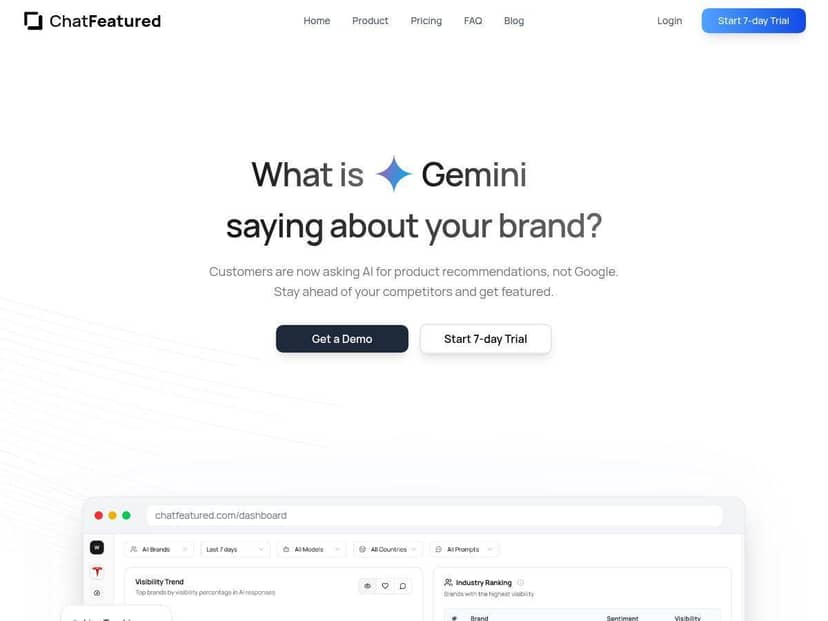
ChatFeatured Review: What I Tested (and what I actually saw)
Here’s how I tested it so the results aren’t just vibes. I tracked a brand name in the “analytics + marketing tools” space and used a set of repeatable prompts tied to common buyer questions. I ran the tests over about 14 days, checking the dashboard multiple times per week to see whether mentions were trending up, flat, or dropping.
Queries I used: I focused on prompts that typically trigger list-style answers and “best tools” comparisons. Examples included:
- “What are the best tools to monitor brand mentions in AI answers?”
- “Compare ChatGPT and Gemini recommendations for [brand/category].”
- “Which tools help with GEO visibility for AI search results?”
- “What’s a good competitor monitoring tool for AI model mentions?”
What I checked in the dashboard: not just whether the brand appeared, but how consistently it showed up across different models. I also watched for how quickly updates appeared after changes (more on that in the “How it works” section).
What I noticed right away: ChatFeatured does a decent job making AI “visibility” feel measurable. The dashboard is clean, and the reporting is easier to interpret than most SEO-style dashboards I’ve used. You can actually tell what’s happening without needing to reverse-engineer the logic.
That said, I’ll be straight with you: AI mentions aren’t as stable as traditional rankings. Even when you do everything “right,” models can shift wording, citation behavior, and list composition. ChatFeatured helps you spot those shifts—you still need to act like it’s an ongoing process, not a one-time fix.
Key Features That Matter (not just feature names)
- Cross-Platform AI Monitoring: Track brand mentions across major models (I saw coverage including ChatGPT and Gemini, plus others depending on your plan).
- Competitor Analytics: Benchmark your visibility against competitors and identify where your brand is missing from the “shortlist” answers.
- Real-Time Tracking: The UI is built around frequent updates so you’re not waiting weeks to find out something changed.
- GEO Insights: Helps you see how mention behavior differs by location—useful if your audience isn’t global.
- AI-Optimized Content Tools (Beta): Content suggestions aimed at improving how AI models cite or reference your pages.
- Actionable Recommendations: Not just generic advice—recommendations are tied to the prompts and coverage patterns you’re monitoring.
- Multi-Channel Support: Depending on the plan, you can get alerts via email and integrations like Slack.
How It Works (and what “mentions” really mean)
This is the part I wish more GEO/AI visibility tools explained clearly upfront. So here’s how I understood it while using ChatFeatured.
What counts as a “mention”?
In my experience, a “mention” is when your tracked brand name (or the identifiers you set) shows up in the model’s response to a monitored prompt. That can include being listed as a recommendation, referenced in a comparison, or named as part of a “tools like X” answer.
Important: a mention isn’t the same thing as “being cited” in a way that looks like a link to your website. AI outputs vary—sometimes the model names you without quoting a source, and sometimes it includes references/citations.
How citations and AI-optimized content connect
ChatFeatured’s content tools (beta) are designed to help you write/adjust pages so they’re easier for AI systems to reference. In practice, that usually means:
- Making sure your page clearly answers the prompt-type questions you’re tracking.
- Using language that matches how models describe the topic (not keyword stuffing—more like “answer shape”).
- Structuring content so it’s easier to summarize (headings, comparisons, FAQs, and “best for” sections).
Do you get instant “we wrote one paragraph and now we rank everywhere”? No. But you do get a more direct path from “we’re not mentioned” to “here’s what to change on the page.”
A simple workflow I followed
- Pick 10–25 prompts that match buyer intent (best tools, comparisons, how-to, and “for X” questions).
- Track your brand + 3–5 competitors so you can see patterns, not just raw mentions.
- Review GEO splits if location matters. Even a small difference can explain why you’re “in” for one audience and missing for another.
- Use recommendations to adjust the most relevant pages (usually category pages, comparison pages, and FAQs).
- Re-check after changes on a consistent schedule (I used 48–72 hours for initial checks, then weekly for trends).
Limitations (real talk)
- AI outputs are inconsistent. Even if nothing changes on your site, models can change their phrasing and list composition.
- Setup takes your attention. The prompts you choose matter a lot. If you track generic queries, you’ll get generic results.
- Beta features can be rough. When I tested the AI content tools, I had a couple moments where the suggestions felt less precise than the monitoring insights. It improved after I adjusted the prompts to match my niche better.
Pros and Cons (based on my test)
Pros
- Dashboard clarity: I didn’t feel lost. The monitoring view is easier to scan than I expected.
- Competitor benchmarking is actually usable: I could tell where competitors were showing up in prompt categories I cared about.
- GEO insights add a real dimension: It’s not just “you’re mentioned or you’re not.” Location differences can explain why results look random.
- Recommendations connect to monitoring: The suggestions felt tied to prompt performance rather than generic advice.
- Multi-model tracking: Seeing the same query across multiple models helped me avoid false conclusions.
Cons
- Beta content tooling isn’t perfect yet: It’s helpful, but I wouldn’t treat it as a fully automated “publish and done” workflow.
- Pricing can be steep for smaller teams: If you only need a handful of prompts, the cost may not feel worth it.
- Integrations could be tighter: I wanted more “plug directly into our workflow” options instead of extra steps to turn insights into tasks.
Worked Examples: Prompts → Recommendations → Actions
I’m going to show you a few concrete examples of how this kind of tool should be used. These are based on the prompt patterns I tested (I’m keeping brand/category wording anonymized where needed).
Example 1: “Best tools” prompt and missing shortlist placement
Monitored prompt: “What are the best tools to monitor brand mentions in AI answers?”
What I noticed: My brand showed up occasionally, but a competitor was mentioned more consistently across the same prompt set.
Recommendation I got: focus the most relevant page on “brand mention monitoring” with a clearer comparison section (including what’s tracked, how often, and what users get).
Action I took: I updated a category page with:
- A short “What we monitor” section (bullets)
- A “How visibility improves” section (what changes you can make)
- A comparison block: “Tool A vs Tool B” style (without being overly salesy)
Result (what I could verify): After the update, my brand’s mention frequency improved for the “best tools” prompt category on at least one model. It wasn’t instant across all models, but it moved in the right direction.
Example 2: GEO prompt and location-specific mentions
Monitored prompt: “Which tools help with GEO visibility for AI search results?”
What I noticed: Mentions looked noticeably different between locations. In one GEO slice, my brand appeared in the response more often, while another slice barely mentioned me.
Recommendation I got: add location-relevant examples and clarify audience targeting on the relevant pages (especially “who it’s for” and “how it works by region”).
Action I took: I added a small “Regional use cases” section and an FAQ that answered questions like:
- “Do results vary by location?”
- “How should local brands set up tracking?”
Result (what I could verify): The GEO-specific mentions became more consistent on the slice where we had the strongest relevance. That told me the tool wasn’t just tracking noise—it was reflecting how AI responds to content specificity.
Example 3: Competitor analytics and content gap detection
Monitored prompt: “Compare ChatGPT and Gemini recommendations for [brand/category].”
What I noticed: One competitor was cited more often in responses that compared capabilities, while my brand was mentioned more in “definitions” and “what is” type answers.
Recommendation I got: create/strengthen a comparison format page (features + tradeoffs + who should choose what).
Action I took: I built a “comparison” section with clear headings and a short “best for” summary at the end.
Result (what I could verify): After updating, the model behavior shifted—my brand started appearing more in comparison-style answers. Again, it wasn’t universal across every model, but the direction was clear.
Pricing Plans (and who they fit best)
ChatFeatured offers three plans:
- Basic: starts at $89/month. Includes monitoring on key AI models, 25 prompts, and GEO audits.
- Pro: $199/month. Adds more models, 100 prompts, and advanced support via Slack and email.
- Enterprise: $449/month. Covers 300+ models, unlimited prompts, and priority assistance.
My take? If you’re a freelancer or small shop and you only care about a couple prompts, it can feel pricey. But if you’re serious about improving AI visibility for a real product/category—and you’re willing to update content based on what the dashboard shows—those prompt limits can be worth it.
Who ChatFeatured is for (and who should skip it)
- Good fit: brands and marketing teams that already publish content (guides, comparisons, landing pages) and want to measure whether AI models actually mention it.
- Great fit: teams that care about competitors and want to spot content gaps based on prompt performance.
- Maybe not: if you don’t plan to take action on insights (no content updates, no landing page improvements). Tools like this work best when you treat them like a feedback loop.
Wrap up
ChatFeatured impressed me most with two things: the multi-model monitoring makes the problem feel measurable, and the competitor/GEO views help you avoid guessing. The beta content tools aren’t flawless yet, but the monitoring insights are strong enough that you can still use the platform to guide real page updates.
If your goal is “get mentioned by AI” (and actually improve over time), ChatFeatured is worth a look. Just don’t expect it to replace SEO or marketing—think of it as an extra measurement layer for the AI answers your customers see.