Table of Contents
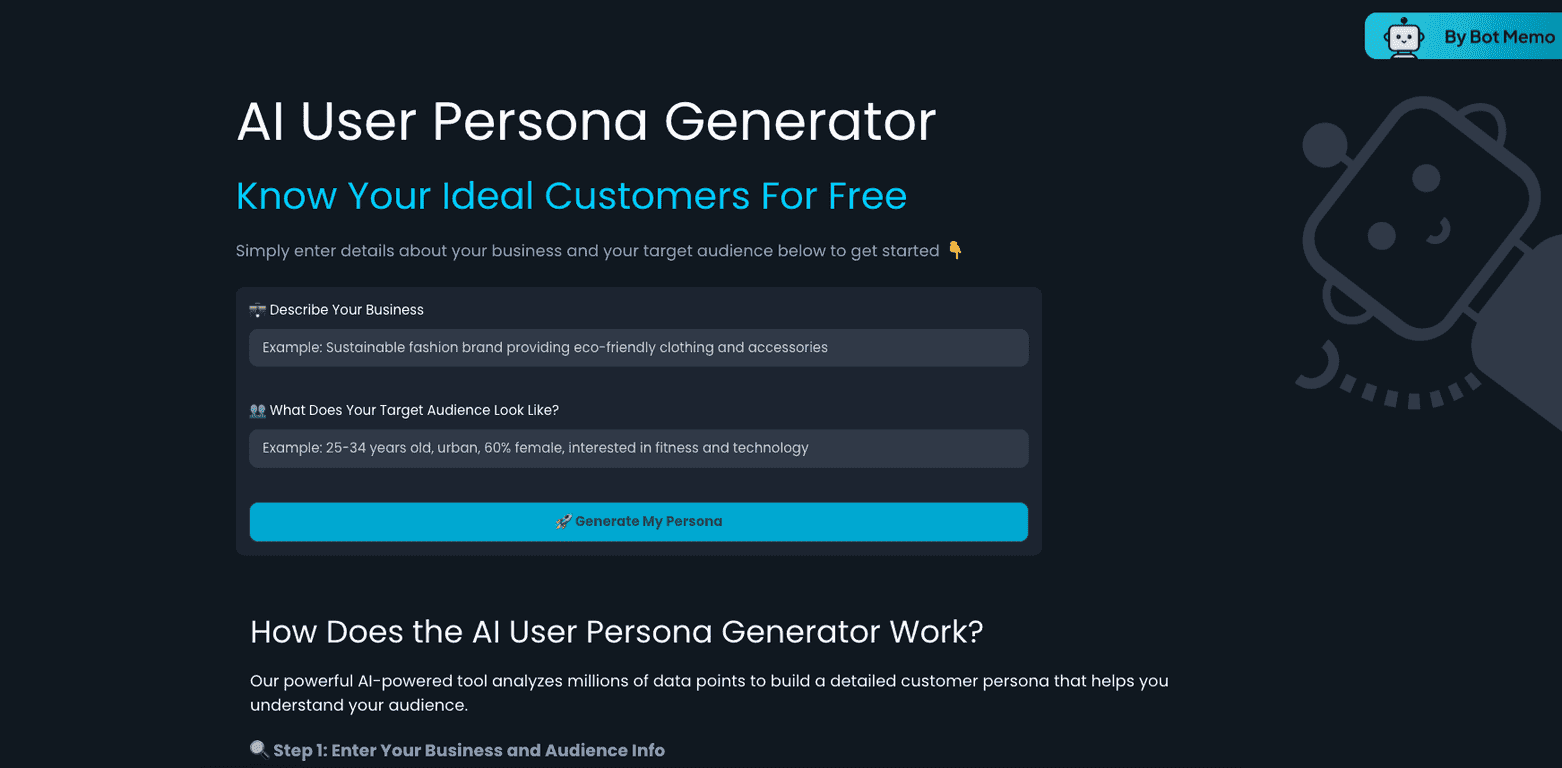
If you’re trying to market to the “right people,” you need more than vibes. In my experience, the fastest way to get clarity is to start with a solid user persona—even if it’s a first draft. That’s where the AI User Persona Generator from Bot Memo comes in. It’s a free tool that builds persona-style profiles from the inputs you provide, then turns that into something you can actually use for marketing and product decisions.
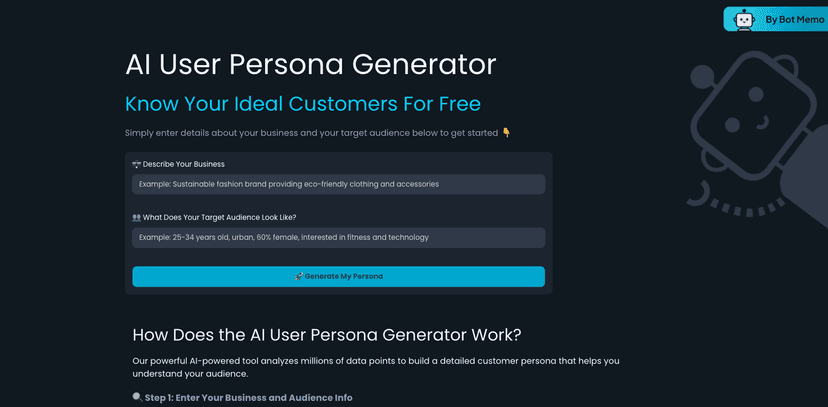
What I like about it is that it doesn’t make you jump through hoops. You’re not spending an afternoon writing surveys or hunting for spreadsheets just to get started. You give it some key details about your business and the audience you’re targeting, and it generates a persona report that includes the usual suspects: demographics, preferences, pain points, and motivations.
Now, let’s be real—AI personas aren’t magic. They’re only as good as the inputs you feed them. But if you’re stuck at the “we think our customers are…” stage, this tool can help you move forward quickly. It’s the difference between staring at a blank page and having something concrete to refine.
AI User Persona Generator Review (What I Noticed Using It)
When I tested the Bot Memo AI User Persona Generator, the biggest thing I noticed was how quickly it turns “inputs” into a structured persona report. You’re not just getting a wall of text. You get sections that help you visualize a real customer.
Here’s what that looks like in practice: if you tell it your business type, your product category, and who you want to reach, it generates insights around:
- who the persona is (demographics and general background)
- what they care about (preferences and motivations)
- what frustrates them (pain points)
- what would make them choose you (the “why now” angle)
That’s exactly the stuff you need when you’re planning landing pages, ad copy, or even onboarding flows. For example, if the report emphasizes “time savings” and “low setup effort,” you can turn that into a headline like “Set up in 10 minutes” instead of a generic “We help you grow.” Small changes like that can make a big difference.
One more thing: it’s helpful for brainstorming. If you’re trying to decide between two positioning options, persona outputs give you a reason to pick one. Does your audience seem overwhelmed by complexity? Lean into simplicity. Do they value trust? Add proof points. It’s not perfect, but it’s useful.
Still, I wouldn’t treat the first generated persona as final truth. If your inputs are vague (ex: “we sell to small businesses”), the output will likely stay pretty general too. The tool works best when you’re specific—like naming the industry, typical job role, and what problem your product solves.
Key Features
- User-Friendly Form: The input process is straightforward. You can get a result without needing to be a research expert. In my opinion, this matters because most persona tools fail at the “getting started” step.
- AI Analysis: It uses AI to interpret your inputs and generate persona content. The output is organized enough that you can skim it and still pick up the key themes.
- Detailed Persona Reports: You get a fuller persona snapshot, not just one-liners. Typically you’ll see demographics, preferences, pain points, and motivations called out in a way that’s easy to reference.
- Actionable Insights: The tool doesn’t only describe the persona—it helps connect them to marketing and product decisions. That’s the part I actually use when I’m writing messaging.
- Free Access: It’s completely cost-free. If you’re a startup or freelancer, that alone makes it worth testing.
Pros and Cons
Pros
- Comprehensive Insights: The personas cover multiple angles (preferences, pain points, motivations), which makes it easier to build campaigns that feel tailored.
- Cost-Effective: Since it’s free, I think of it as a quick drafting tool. You can generate versions and compare them without worrying about budget.
- Quick Generation: You can go from “we’re not sure who this is for” to a usable persona in minutes. That speed is a real advantage over traditional research.
- Data-Driven Feel: The outputs read like they’re grounded in market patterns rather than random guesses—at least enough to get you moving.
Cons
- Basic Information Required (and it shows): If your inputs are thin, the persona will be thin too. Garbage in, garbage out—just like anything else.
- Not a Replacement for Real Research: This won’t replace customer interviews, surveys, or sales call notes. I see it best as a starting point or a way to structure your thinking.
- Limited Depth on Engagement: Because it’s not learning from direct conversations with your customers, it may miss nuance you’d normally get from actual user feedback.
Pricing Plans
Free: The AI User Persona Generator is accessible at no cost. It’s aimed at entrepreneurs and small businesses who want a practical way to understand their audience without spending money upfront.
Wrap up
Overall, I think the AI User Persona Generator is a solid option if you want something fast and usable. It’s not going to replace interviews or analytics, but it can absolutely help you get unstuck and tighten your messaging. If you’re building a new offer, writing your first landing page, or trying to figure out what to say in ads, having a persona draft you can refine beats guessing every time.
If you try it, my advice is simple: be specific with your inputs. The more detail you give it about your audience and the problem you solve, the more helpful the output will be.
Promote AI User Persona Generator