Table of Contents
A fiction author without an established name might be offered US$5,000–$50,000, or £1,500–£25,000 in the UK. Those broad estimates come from the editors and agents interviewed for Reedsy’s February 2026 author-income guide. They give you somewhere to start, but there isn't one reliable average that tells you what your manuscript should fetch. Small presses can pay less, and a publisher competing hard for a book can pay much more.
The number on the offer is only the beginning. A $30,000 deal sounds better than a $20,000 deal until you discover that the first buys two books and the second buys one. Then there is the payment schedule: money due on publication won't pay a research bill that arrives while you're still writing chapter three.
Below, we'll follow the money from the offer to your bank account. You'll see how a $24,000 advance becomes four $5,100 payments after a 15% agent commission, how royalties pay down an advance, and why a publisher's claim to your next book or audiobook can matter as much as a bigger signing check. All dollar examples use US dollars.
A book advance is an advance payment against the author's future royalties and other earnings specified in the publishing agreement. Those earnings first offset the advance; additional royalties become payable after the relevant account earns out. The Society of Authors explains this arrangement for general consumer publishing. (societyofauthors.org)
If you've been comparing advances online, the conflicting answers can be frustrating. One writer may be discussing a first novel, another a celebrity memoir, and another an entire series. We'll keep those differences visible while giving you a practical way to judge an offer for the book you're actually writing.
The Authors Guild describes its model contract as educational guidance, not legal advice. Its suggested terms are negotiating guidance, not a promise that every publisher offers them. Have a qualified publishing attorney, agent, or authors' organization review an agreement you may sign. (authorsguild.org)
Why book-advance averages are difficult to compare
Compare your offer with deals for similar books. A US debut novel and a UK nonfiction book with an established audience aren't competing for the same budget. Check when a reported deal happened, which currency it uses, how many books it covers and which rights were sold. Even the word “advance” can refer to a whole deal or just the first payment.
An average also depends on who shared their numbers. A few enormous deals can pull the mean upward, while a median tells you the middle figure in that particular group. Neither solves the problem of missing contracts. Before treating a genre's reported range as your target, find out how many authors it includes and how their deals were chosen.
Annual author income is also not an average advance. For example, the Authors Guild's 2023 survey reported median book income of $10,000 for full-time authors in 2022. Its definition combines advances, royalties, and licensing or subsidiary-rights fees. That figure describes annual income for the surveyed group, not the amount offered for a debut manuscript. (authorsguild.org)
Deal announcements are still useful. They can help you find agents who sell books like yours, editors who buy them and recent titles to read before submitting. Bring those examples to an adviser who knows your category. Ask which deals really compare with yours, especially when the territory, number of books or rights package differs.
What a book advance is
An advance brings some author earnings forward; it is not a bonus paid on top of the royalties used to earn it out. The Authors Guild model advance clause describes a non-refundable payment offset against royalties and other author sums under the agreement. Its accounting model also specifies that an unearned advance is not an overpayment. (go.authorsguild.org)
Separate poor sales from contractual nonperformance. Failure to earn out is not the same event as failing to deliver the agreed manuscript. Delivery, rejection, termination, warranties, and indemnities need separate review; the Authors Guild's model termination provisions illustrate circumstances in which repayment obligations can arise. A reassuring advance clause does not replace those provisions. (go.authorsguild.org)
Keep three numbers handy: the advance promised in the contract, the payments you've received and the balance your royalties still need to cover. They answer different questions. Your first installment tells you what you can spend now; the royalty statement tells you how close the book is to earning additional payments.
Compare the money you get for each book
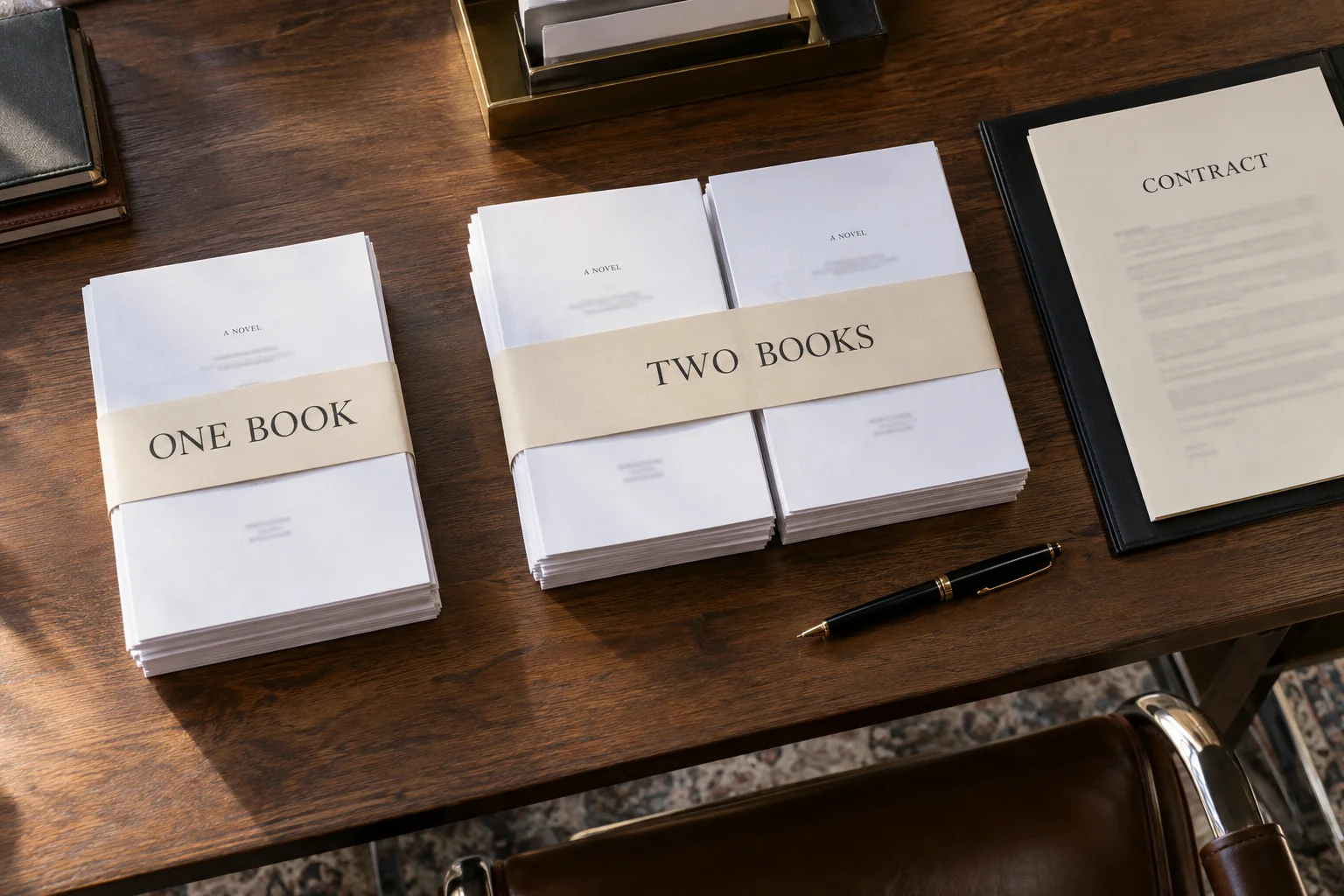
Start with the amount allocated to the manuscript you are deciding whether to sell. Suppose Offer A guarantees $30,000 for two books, expressly allocated as $15,000 per book. Offer B guarantees $20,000 for one book. A is the larger package; B is the larger first-book commitment. If a package has no stated allocation, request one rather than assuming an equal split.
Count the money the publisher has actually committed to pay, assuming you meet the contract's requirements. Put possible bonuses and future-book options on separate lines. A bonus for reaching a sales target may be exciting, but it can't cover today's expenses. An option to discuss your next book isn't automatically a promise to buy it.
| Field | What to record | What to compare |
|---|---|---|
| Guaranteed money | Amount, currency, and conditions attached to payment | Committed compensation, excluding speculative bonuses |
| Books covered | Advance allocation and delivery obligation for each book | Payment per manuscript, not just package size |
| Payment schedule | Each installment, trigger, payment deadline, and outside date | Cash arriving before and after the work is completed |
| Earn-out scope | Books, formats, territories, and licensing income sharing an account | Which earnings must clear which balances |
| Rights granted | Formats, languages, territories, duration, and subsidiary rights | What the publisher receives for the money |
| Verification and exit | Statements, audit access, reserves, publication obligations, and reversion | Your ability to check earnings and recover unused rights |
The Authors Guild grant-of-rights commentary identifies territory, term, and formats as central limits of a publishing license and discusses language and sublicensing rights. Use those dimensions to describe the grant precisely. “English-language rights” alone does not finish the comparison; add where, in which formats, and for how long. (go.authorsguild.org)
For each right, write down whether you're keeping it, granting it or still negotiating. If the publisher wants audio or translation rights, ask about its plans for them. If you keep those rights, consider who will sell or produce those editions. Keeping a right can create another opportunity, but that opportunity only becomes income when you have a paying deal.
When will the advance reach your bank account?
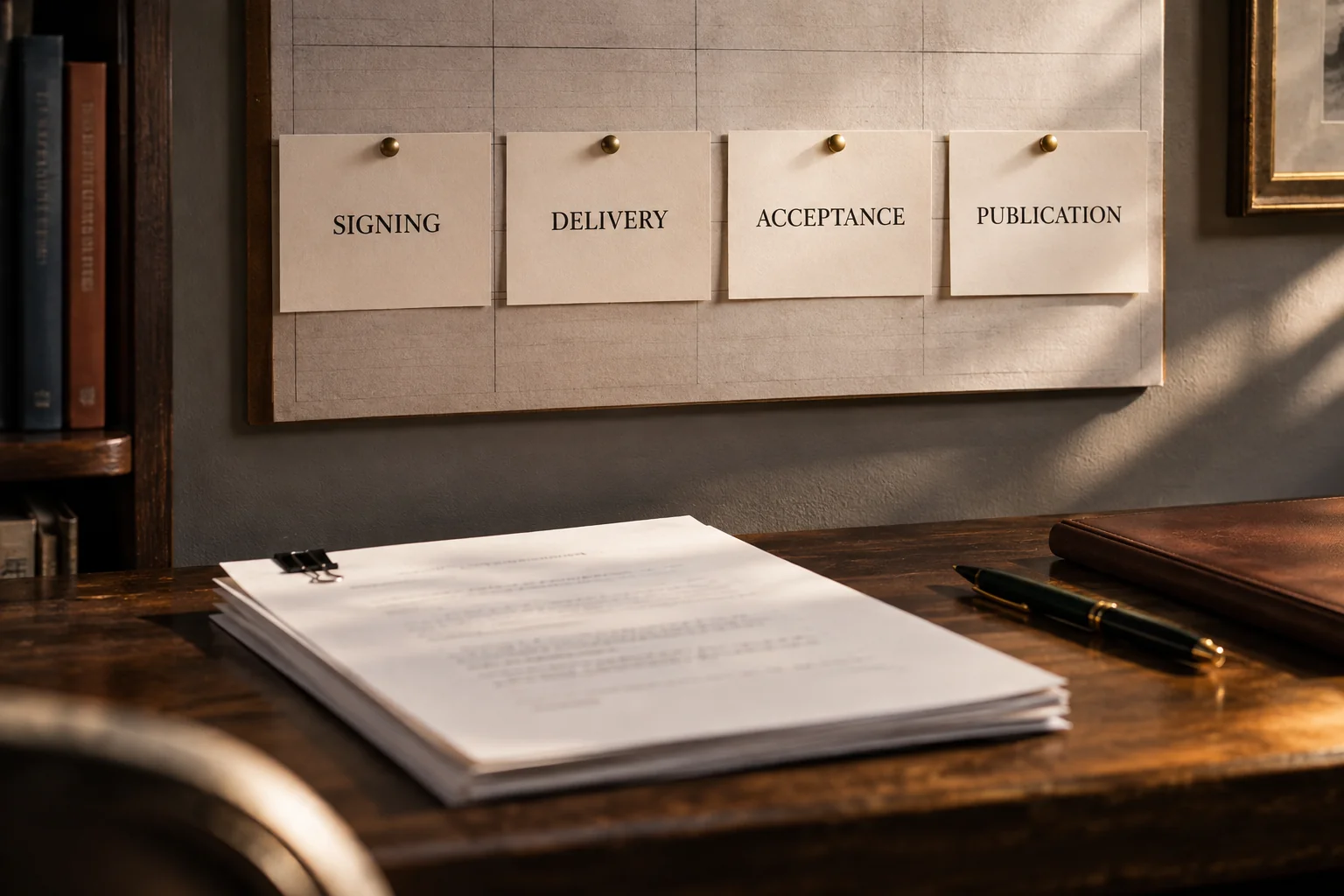
Give every installment its own budget line; the full advance is not necessarily the signing payment. The model advance commentary lists execution, manuscript milestones, acceptance, publication, and later dates as possible installment triggers. Alongside each trigger, record the amount, the deadline for payment after the trigger, and any outside date that prevents an indefinite wait. (go.authorsguild.org)
Distinguish delivery from acceptance. Delivery concerns submitting the contracted work; acceptance adds a publisher decision about whether it meets the agreement. The Authors Guild's delivery guidance addresses manuscript requirements, review periods, and revision requests. Ask your adviser to identify the required deliverables, the publisher's response deadline, and the procedure following requested revisions. (go.authorsguild.org)
Let's take a $24,000 advance split into four payments of $6,000. At the Authors Guild's generally stated 15% domestic book-publishing commission, your agent receives $900 from each payment and you receive $5,100 before tax and agreed expenses. Across all four payments, that leaves $20,400. Check your own agency agreement before copying those figures into your budget. authorsguild.org
| Hypothetical trigger | Gross installment | Assumed 15% commission | Remainder before tax and expenses |
|---|---|---|---|
| Signing | $6,000 | $900 | $5,100 |
| Manuscript acceptance | $6,000 | $900 | $5,100 |
| Publication | $6,000 | $900 | $5,100 |
| Twelve months after publication | $6,000 | $900 | $5,100 |
| Total | $24,000 | $3,600 | $20,400 |
Here's one possible payment schedule, rather than a schedule every publisher follows. If a payment depends on publication, ask what happens if publication moves back six months or a year. A firm latest payment date can matter a great deal when your living expenses keep arriving even though the book's release date has changed.
Now put your costs beside those payment dates. Research travel, permissions and other agreed expenses may need paying before the manuscript is accepted. In this example, the first payment gives you $5,100 before further deductions. Build your early spending around that amount, and allow for tax and the time your agent needs to pass the money on.
After signing, set reminders for due payments and statements. The Society of Authors recommends tracking these dates, checking any invoicing requirements, and following up promptly when money is overdue. Its housekeeping guidance also recommends tracking sublicensing payments and license expiry dates. (societyofauthors.org)
How many sales does it take to earn out?
Calculate earn-out from credited author earnings, not cover-price sales revenue or copies alone. Royalty percentages may apply to a retail price or to publisher receipts, so the percentage needs its calculation base. The Society of Authors explains this distinction in its payment guidance. (societyofauthors.org)
For a scenario with one constant royalty credit, use:
Qualifying units needed = remaining unrecouped advance ÷ royalty credited per qualifying unit, rounded up to a whole unit.
Suppose your advance is $20,000 and each sale credits $2 in royalties. You need 10,000 qualifying sales to earn out. If an applicable licensing payment has already covered $4,000, you need another $16,000, or 8,000 sales at $2 each. The arithmetic is straightforward once you know which earnings count toward your advance.
For an actual offer, make separate rows for hardcover, paperback, ebook, audiobook, direct sales, exports, and deeply discounted sales whenever their royalty calculations differ. Record the base, rate, and resulting credit. Add applicable licensing receipts separately. Then account for returns, reserves, and adjustments rather than forcing every transaction into a single average royalty. The Authors Guild's royalty and accounting sections identify these distinctions and reporting items. (go.authorsguild.org)
Before totaling the earnings, check which books and editions share an account. These questions make a real difference:
- Does each book earn out independently, or can one book's earnings offset another's advance?
- Do print, ebook, and audio earnings share the same balance?
- Which translation, territorial, and subsidiary-rights payments count toward that balance?
- Are bonuses additional compensation, further advances, or conditional payments?
- Can the publisher apply earnings from another agreement to this account?
To see why scope matters, model two books with $15,000 advances each. Assume book one has generated $18,000 in credited earnings and book two $2,000. With strictly separate accounts and no other adjustments, book one has $3,000 above its advance. If those balances are pooled instead, combined earnings of $20,000 still leave $10,000 of the $30,000 package unrecouped. This example illustrates the accounting difference; it does not assume either treatment applies to your offer.
If you can't answer one of those questions, ask the publisher or your adviser to point to the relevant wording. “Print, ebook and audio” lists the editions involved, but doesn't tell you whether a successful audiobook can pay down the print advance or whether each edition earns out separately.

Check your royalty statements and rights
Ask for enough statement detail to reproduce the royalty calculation and follow the advance balance. The Authors Guild model accounting clause includes format-level quantities, the applicable price or receipts, royalty rates, returns, reserves, and licensing proceeds. It also calls for statements even when no payment is due. (go.authorsguild.org)
A sample royalty statement is worth asking for before you sign. Pick one sales line and work through the quantity, price, royalty rate and deduction. Can you reach the same total? If you can't, ask for an explanation. You'll learn more from one clear answer about a specific deduction than from a general promise of transparent accounting.
Check the audit clause separately. The Authors Guild's model addresses access to records, notice, audit costs, and reimbursement when an examination identifies a sufficiently large underpayment. Record your contract's actual conditions rather than assuming that a right to receive statements automatically includes an effective right to inspect the underlying records. (go.authorsguild.org)
The Authors Guild royalty commentary explains reserves against returns: amounts withheld to allow for copies that may come back unsold. Ask which sales qualify, how the reserve is calculated, whether it has a cap, and when it must be released. Require enough reporting to distinguish a new reserve from the application or release of an older one. (go.authorsguild.org)
Evaluate the route out of the contract as carefully as the route to payment. The model reversion section provides out-of-print and earnings-based approaches, plus provisions addressing unexploited foreign-language and audio rights. These are model negotiating terms, not automatic rights in every agreement. (go.authorsguild.org)
Imagine your ebook stays on sale for years but barely earns anything. Would the contract let you ask for your rights back? Read the sales or earnings threshold, the period it covers and the notice you must give. Also check how long the publisher has to respond and what happens to licenses it has already sold.
A $30,000 deal versus a $20,000 deal
Offer B pays more for your first book; Offer A gets more money to you sooner. The two sample offers below show why both points matter. They cover US domestic English-language publishing and use US dollars. Some terms still need negotiating, just as they often do when you first receive a short offer rather than a complete contract.
| Decision line | Hypothetical Offer A | Hypothetical Offer B |
|---|---|---|
| Package guarantee | $30,000 for two books | $20,000 for one book |
| Allocation to book one | $15,000 | $20,000 |
| Book-one signing installment | $7,500 | $5,000 |
| Remaining book-one payments | $7,500 on acceptance | $5,000 each on acceptance, publication, and twelve months after publication |
| Audio rights | Granted to publisher | Retained by author |
| Cross-application between books | Unresolved; request exact clause | No second book in this offer; check other offset language |
| Outside payment dates | Unresolved | Unresolved |
| Accounting, reserves, and reversion | Review complete clauses | Review complete clauses |
B guarantees $5,000 more for the first manuscript and retains audio rights for the author. A pays $2,500 more at signing. By acceptance, assuming those installments have become due and been paid, A supplies all $15,000 of its book-one advance; B supplies $10,000, with another $10,000 scheduled later. A's second-book installment schedule is unspecified and should not be silently added to this first-book cash comparison.
For Offer B, you might ask to move more money to signing or acceptance, then agree on latest dates for the later payments. For Offer A, ask whether the books earn out separately and what the publisher plans for audio. Think about your workload too: the extra book is another deadline and another creative commitment.
Audio rights deserve their own conversation. Keeping them means you can pursue an audiobook deal, but someone still has to find a buyer or arrange production. Granting them may be worthwhile if the publisher has a convincing plan. Ask who will do the work, when it should happen and what your contract promises if it doesn't.
Then compare the publishers' proposed editorial approach, production timetable, distribution, and sales plans. Examine relevant books they have published and discuss the fit with an adviser who knows your category. Keep contractual commitments distinct from encouraging conversations. The table can reveal financial trade-offs; it cannot establish which team will edit or sell the book better.
Questions to resolve before signing
Before signing, make sure you understand what you'll be paid, when you'll receive it and what you're giving the publisher in return. Share the complete contract and offer emails with your adviser. The clause that changes your payment rights may sit several pages away from the advance itself. These questions will help you work through the whole agreement.
- What exact amount is committed to this manuscript, in which currency, and subject to which conditions?
- Which amounts depend on a bonus, an option, another book, or a further publisher decision?
- What triggers each installment, how soon afterward is payment due, and is there an outside date?
- What constitutes delivery and acceptance, and what procedure follows a revision request?
- Which royalties and licensing proceeds reduce this advance balance?
- Can earnings be cross-applied between books, rights, or separate agreements?
- When are statements due, what will they show, and what records can be audited?
- How are reserves calculated, limited, reported, and released?
- Which rights can return to the author, under what measurable conditions, and after what notice?
- What happens to paid and unpaid installments if the manuscript is rejected, publication does not occur, or the agreement terminates?
Write a short note in your own words: what this book pays, what arrives before your next major expense, which rights you're selling, how the advance earns out and when you can recover unused rights. If you can't finish a sentence confidently, put it on your question list. Choose your biggest negotiating priorities before getting lost in smaller details.
Keep that note beside the contract as negotiations continue. A change to the payment schedule or rights clause can alter a deal that previously looked attractive. Once you can explain the offer clearly, you'll be in a much better position to accept it, negotiate a few changes or decide that it doesn't suit your book.